STUDENT
COURSE
MENTOR
partner
MENTOR
SDG

Generative AI now sits inside most of the tools knowledge workers already use, yet adoption inside companies is uneven. The productivity gains organisations report come mostly from a small group of confident users. Most employees sit somewhere else. They are neither early adopters nor refusers. They sit in a hesitant middle: slow to adopt generative AI and uncertain about how it fits into their actual work. This thesis treats that middle group, the majority of knowledge workers in most organisations, as the place where AI adoption is won or lost, and asks:
Where should design intervene so that the middle majority of employees grows into confident, capable users of AI rather than being left behind?
The work focuses on what I call the conditions layer: the leadership behaviours and visible champion practice that decide whether AI becomes a shared capability inside a company or stays as scattered individual experiments. Using a Research through Design approach, I drew on three sources: six interviews with people leading AI transformation inside companies, a self-ethnographic log of my own daily tool use, and theoretical work on constructivist learning, Knowles’ andragogy, Kapur’s Productive Failure, ICAP (active learning), and the Champion Model.
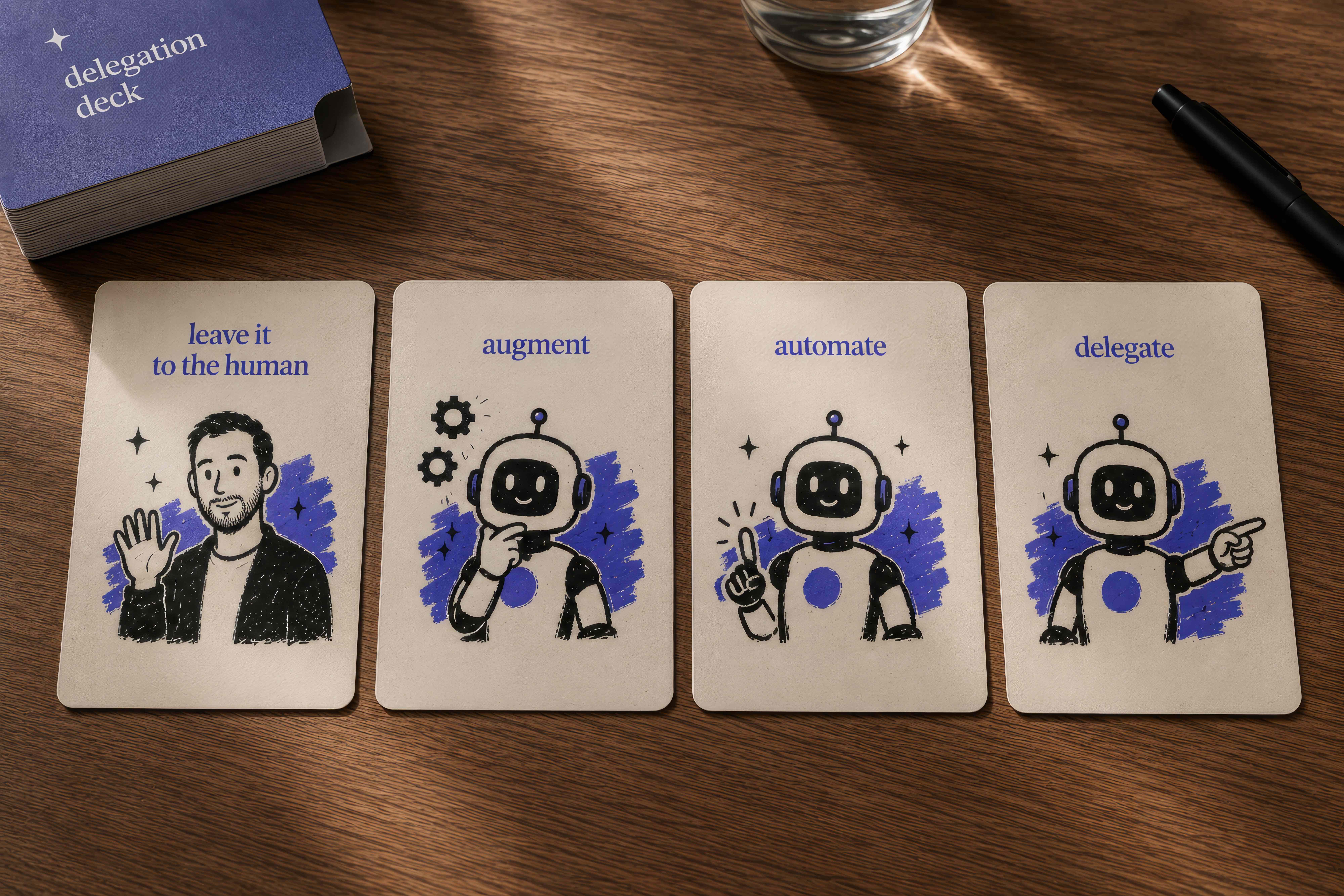
From this material I designed a method built around a workshop, supporting materials, and a facilitator kit, and piloted it through one full workshop run with a leader-and champion pair at an event marketing company. At the centre of the method is a session in which a leader and an internal champion walk through one real workflow together, deciding which cognitive moves can be handed to AI and which should stay with them. The facilitator scaffolds the analysis with
them once, so they can run it themselves next time. This scaffolded walk-through is the core mechanism of the method.
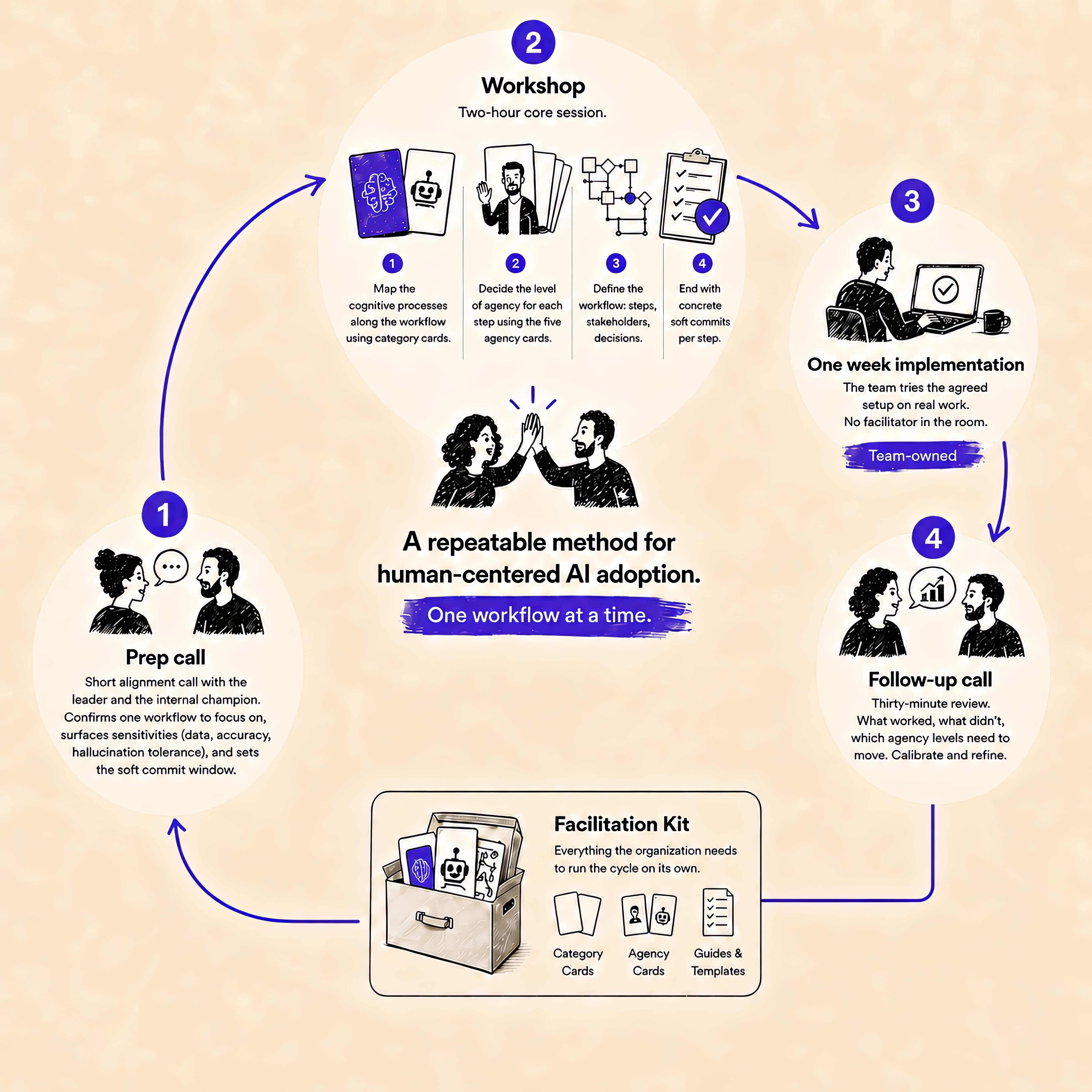
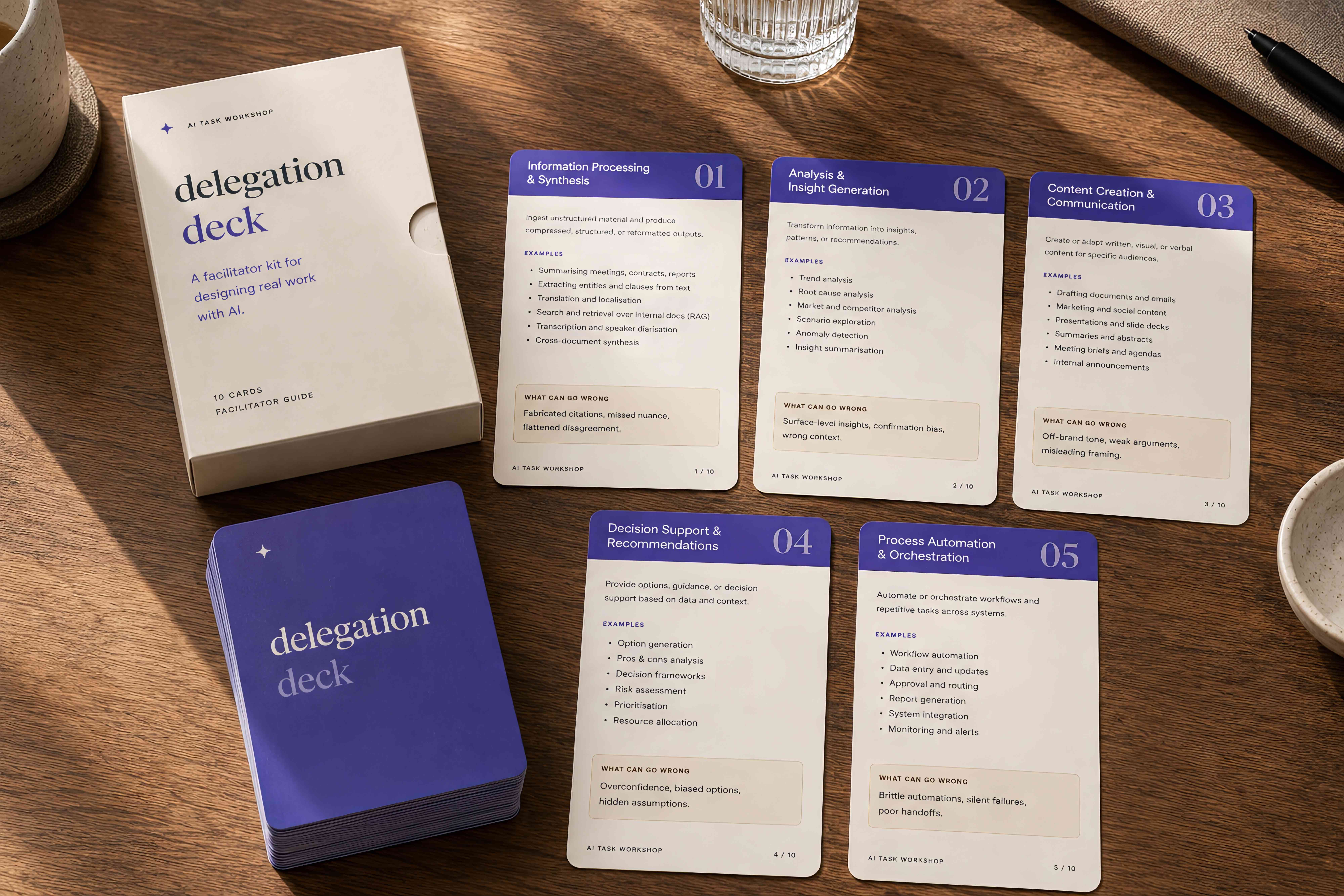
For leaders, the method offers a repeatable way to coordinate AI adoption around a real workflow; for internal champions, it legitimises their practice and turns isolated expertise into routines a team can reuse, making that contribution visible and recognisable inside the organisation. The intended impact is that the middle majority moves from hesitant experimentation to confident, everyday use of AI in their own workflows, supported by visible leadership and shared team routines rather than left to figure it out alone.
The main finding is that the bottleneck sits at the conditions layer rather than at individual skill. People generally know the tools exist; what they lack is permission to use them visibly, visible examples from leaders, and a shared language for what good use looks like. The method is an attempt to make those conditions discussable in the workshop and workable after it, through the supporting materials and facilitator kit that carry the conversation back into the organisation.